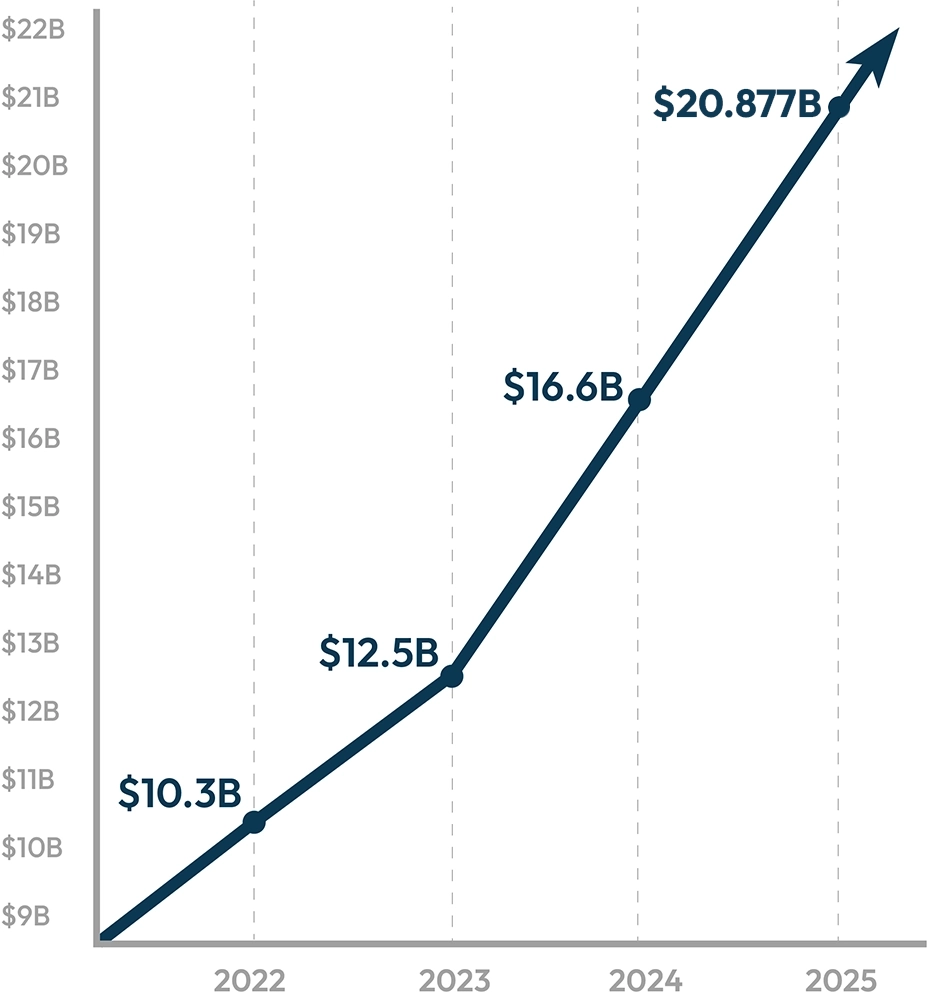
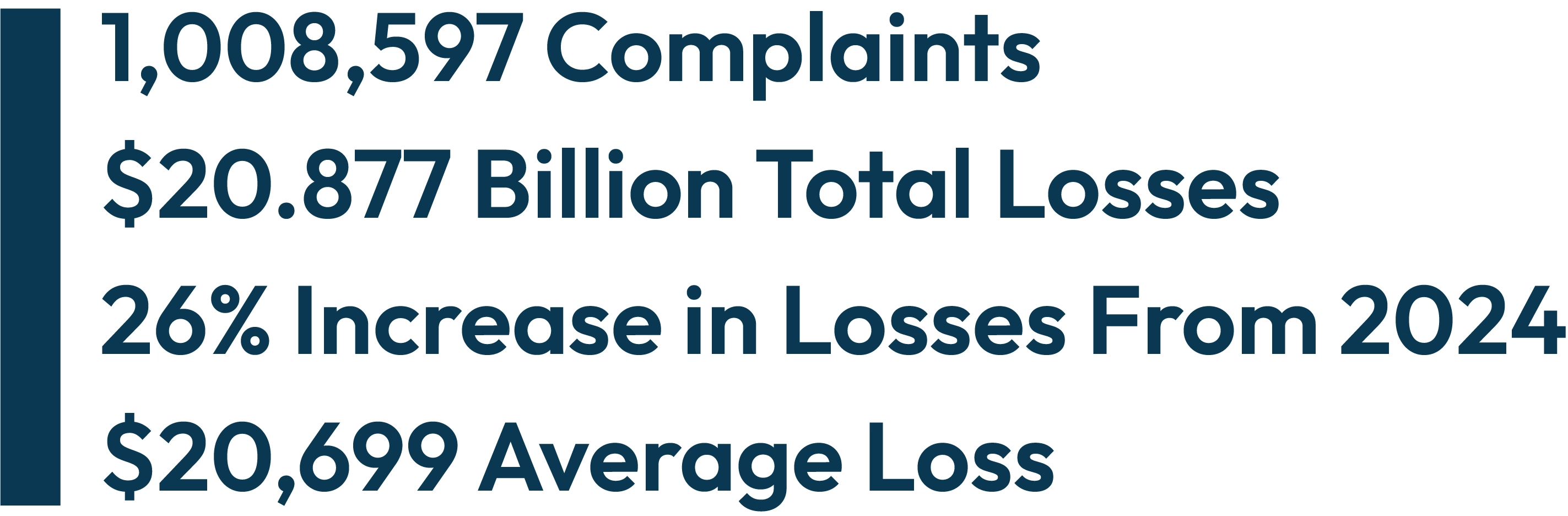
Scam losses have reached unprecedented levels. Americans reported losing $20.877 billion to scams in 2025, a 26% increase from 2024. Since 2022, the reported losses have doubled.
Scammers are getting better at stealing more money. Investment scams, tech support scams, and other long-running schemes are being refined into sophisticated operations capable of taking victims for their entire life savings.
AI is making an already serious problem harder to solve. For the first time, IC3 dedicated a section of its annual report to AI-related cybercrime, documenting more than 22,000 complaints and nearly $900 million in reported losses. AI is helping scammers make existing schemes more convincing, easier to produce, and far easier to scale.
The $20 Billion Question: Why Are Scam Losses Exploding?
August 20th, 2026
Main Takeaways
In April 2026, the FBI’s Internet Crime Complaint Center (IC3) released its 2025 annual report, and one number immediately jumped off the page.
Americans reported losing $20.877 billion to scams in a single year.
That’s up from $16.1 billion in 2024 and $12.35 billion just two years earlier.
Source: FBI Internet Crime Complaint Center (IC3), 2025 IC3 Annual Report.
Billion gets thrown around a lot these days, so it’s easy to lose perspective and become numb to a number like $20.8 billion. Our brains tend to summarize it as “a lot of money.”
Here are some other ways to picture it:
If you spent one dollar every second, it would take more than 659 years to spend $20.8 billion.
If you stacked $100 bills (each bill measures 0.0043 inches thick) perfectly straight up, the stack would reach over 14 miles into the sky.
(If you want to have a little fun in visualizing how much money a billion is, neal.fun created Spend Bill Gates’ Money, a game where you can whittle down $100 billion.)
It’s a truly absurd amount of money, and that’s how much people reported losing to scams in 2025 alone.
Source: FBI Internet Crime Complaint Center (IC3), 2025 IC3 Annual Report.
So, what changed?
The answer isn’t that there is some brand new, extremely successful scam out there raking in massive amounts of stolen money. Instead, there are a few types of scams – investment scams, business email compromise, and tech support scams – that have been around for many years contributing most of the damage.
One thing that also stood out is that, for the first time, the FBI dedicated an entire section of the report to artificial intelligence used in cybercrime. It’s difficult to quantify how much AI has really impacted scams, but it has become another tool scammers are using to make old scams more convincing and much easier to scale. That said, it’s only part of the story.
The Scam That Took Over the Leaderboard
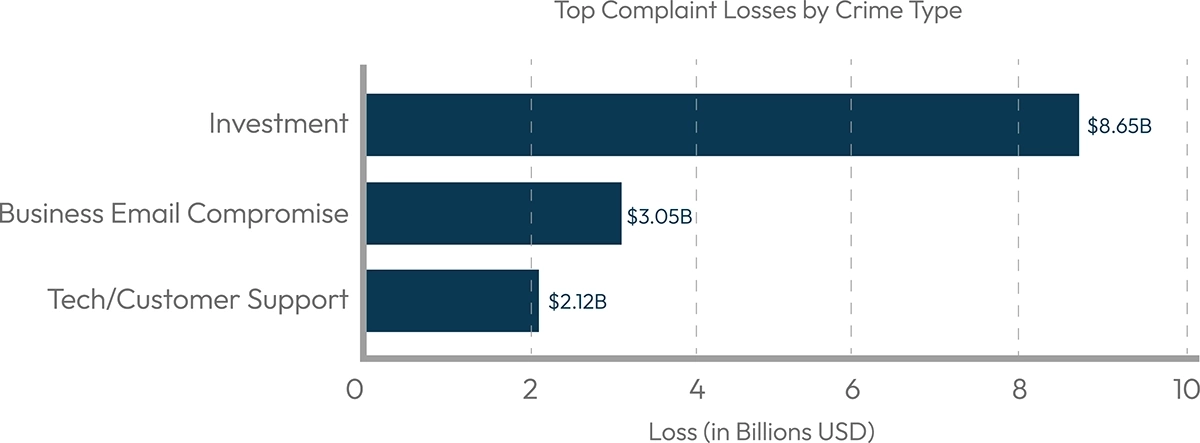
If there’s one category that explains why losses are climbing so quickly, it’s investment scams. They accounted for the largest share of reported losses in 2025 by a landslide.
Source: FBI Internet Crime Complaint Center (IC3), 2025 IC3 Annual Report.
Victims reported losing $8.65 billion to fake investments in 2025, nearly doubling in two years since 2023 when losses were still a massive $4.57 billion.
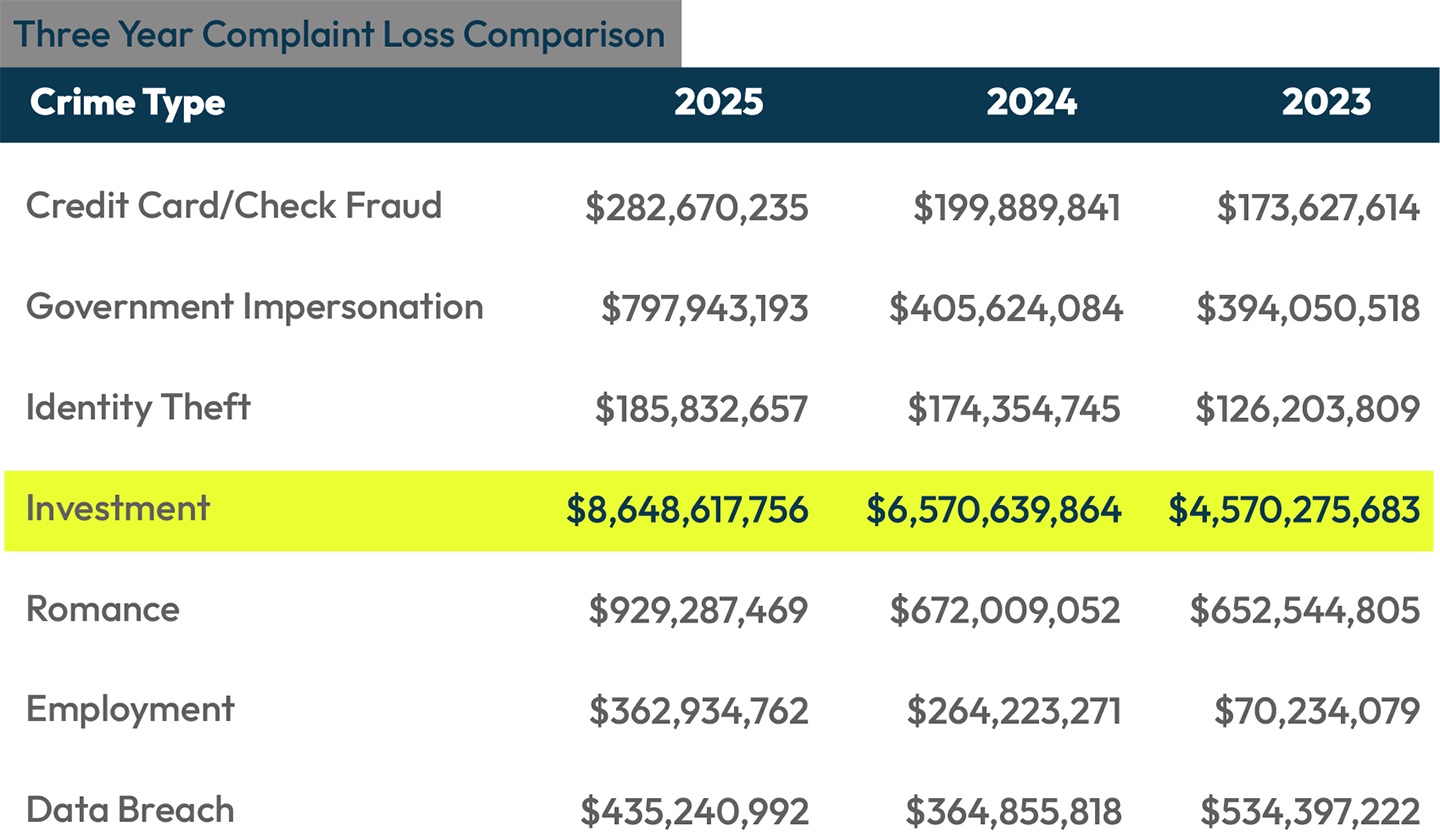
Source: FBI Internet Crime Complaint Center (IC3), 2025 IC3 Annual Report.
Investment scams accounted for roughly 43 cents for every dollar reported lost across the FBI’s scam categories. That raises an obvious question: Why are these scams so costly?
The answer is simple – they don’t aim for small payments. Scammers go after victims’ entire life savings, retirement accounts, business funds, college savings, home equity, and other large dollar amounts. Scammers will even convince victims to apply for loans to invest more.
A fake online shopping scam might cost someone $80. A fake investment scam might cost someone $80,000.
Investment Scams Became An Industry
We’ve watched these scams grow from “get rich quick” schemes into elaborate operations run by call centers that rake in millions of dollars.
These scammers use aggressive marketing campaigns and the likenesses of well-known entrepreneurs and celebrities to make the investment feel legitimate and get the scam in front of as many people as possible.

The opportunity might be “limited-time,” or supposedly powered by “quantum AI” or other advanced technologies, driving people to act quickly for fear of missing out. They use AI to polish their scam websites and investment platforms into something that looks incredibly professional at first glance, and exploit confusion around regulations and filings with the SEC to swindle people interested in investing.

Victims who get drawn in are shown a fake trading app by a personal advisor and promised huge returns with no experience and little effort required. What victims don’t realize is that the scammer can control every aspect of what the victims sees. They are then carefully manipulated into depositing larger and larger amounts of money over weeks or even months into the fake platform.

Every step of the way, scammers reassure victims that their investment is growing. Fake dashboards show impressive returns. Customer service is responsive. The investment “advisor” is knowledgeable and confidently answers questions.
But, when the victim goes to withdraw the money or the scammers have taken them for everything they can, the trap is sprung. Suddenly, there are fees, taxes, and account problems. More money is needed to “unlock” the funds. Every payment is supposedly the last obstacle before money can be released. Customer service disappears, and eventually the website does too. By then, the money is long gone.
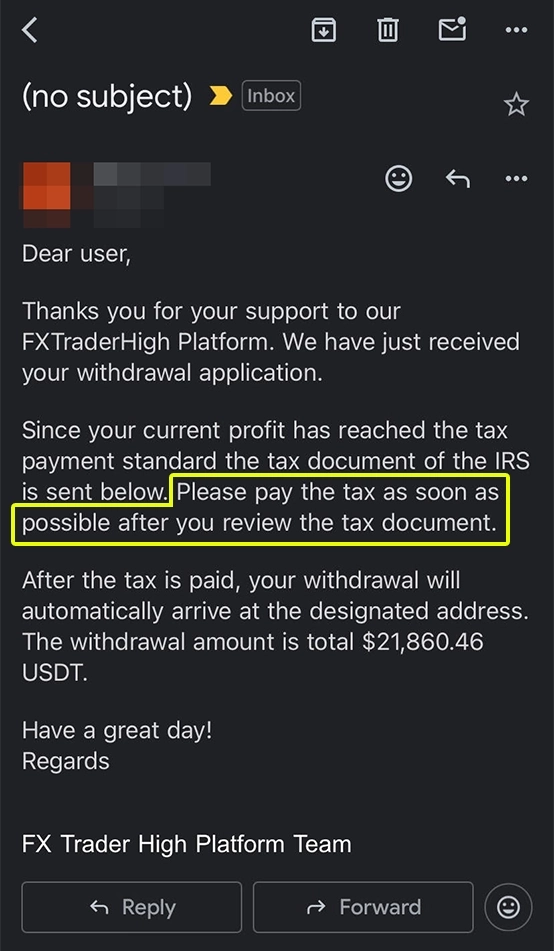
If you haven’t heard of this scam before or want to see how it plays out, Kitboga (legendary scambaiter and one of Seraph Secure’s founders) covered the quantum AI investment scam in full detail in the video below:
The Ponzi Shift
We’ve even seen investment scams turned into full-blown Ponzi schemes. Victims, who believed they were making money, were encouraged to recruit friends and family into the scam to continue to grow their investment. In more sophisticated scams, victims were allowed to withdraw small amounts or were actually paid bonuses (using new victims’ investment money) – not because the investment is real, but because scammers know a small payout builds enormous trust.
After all, if you’ve successfully withdrawn money once, why wouldn’t you invest more?
Or tell everyone you know to do the same?

Fake Investments (with Love)
Sometimes the investment isn’t where the scam begins. Instead, it might start with a simple “hello” from an unknown number, a friendship, or an online romantic relationship.
Romance-investment scams, sometimes referred to as “confidence” or “pig-butchering” scams, are typically slow burns. A scammer might spend weeks or months just talking to victims building trust. They check in daily, ask about work, remember birthdays and important life events, and gradually become part of the victim’s daily routine. In many cases, the relationship develops into a whirlwind romance.
The investment eventually enters the conversation, but rarely as a hard sales pitch. Instead, it might be presented as a shared opportunity: a way for the couple to build a future together, make money for a dream they have discussed, or simply take advantage of an opportunity the scammer claims to have discovered.
Celebrity impersonation scams can use a similar approach, but with a different shortcut to trust. Instead of spending months building a relationship from scratch, scammers impersonate someone the victim already recognizes and admires. They may claim to have a special investment opportunity, offer exclusive access, or develop a personal relationship with the victim through private accounts.

The details may differ, but the goal is the same: get the victim emotionally invested before getting them financially invested. By the time money enters the picture, the victim may already feel deeply connected to the person making the pitch. That emotional connection can make it much harder to recognize the investment as a scam…and even harder to walk away when things start going wrong.
The emotional bond can become so powerful that even concerned friends and family may struggle to convince a victim that the relationship isn’t what it seems. We’ve heard far too many cases where victims continue defending the scammer and sending money because, after being carefully manipulated for so long, the relationship feels very real.
We’ve covered this broader issue in another article Caught In A Bad Romance Scam, diving into steps you can take to help a loved one in this situation.
Tech Support: The Scam that Refuses to Go Away
It’s almost hard to believe that we’re still talking about tech support scams in 2026. They’ve been around for decades now.
Yet, tech support scams still reported losing $2.13 billion in 2025, up from $1.45 billion in 2024 and $924.5 billion in 2023.
But here’s what’s changed.
For a long time, the fake virus pop-up or fake printer support was the scam. Today, it’s often just the first chapter.
Victims encounter tech support scammers in a variety of ways, many still through the classic “fake virus pop-up” screen takeover. The warning message usually claims their device has been infected. Some blast alarming sounds or play a scary message, pretending to be real tech companies like Microsoft and Apple, and instruct panicked victims to call the number on the screen immediately to get help.

Other tech support scams are less jarring and arrive through sponsored search results. Someone searches for a customer support number, clicks on a sponsored ad (which look nearly identical to real search results), and unknowingly calls a scam operation instead.
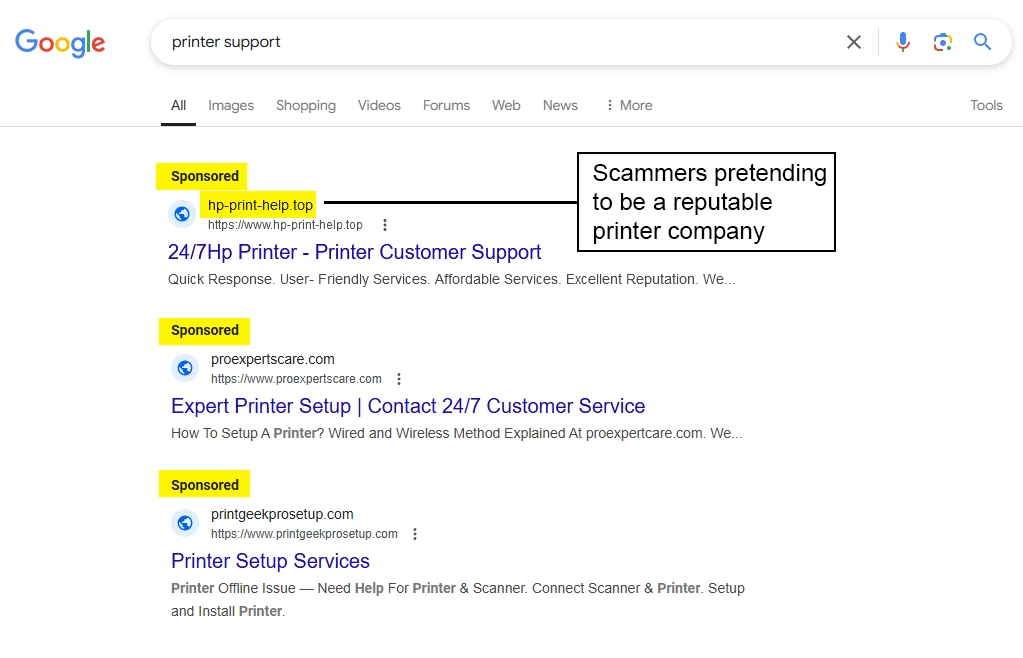
The "Identity Hack" Shift
The growth in money lost to tech support scams is partially fueled by a shift in narrative. Instead of charging a few hundred dollars to “fix” a nonexistent problem like a virus on the computer, many scammers now use that initial phone call as a stepping stone to launch a much larger story, one with potential to take the victim for thousands, even hundreds of thousands, of dollars.
Scammers sometimes now tell victims that the compromise was the result of a much larger attack aimed at the victim’s identity.
They might claim that all the victim’s devices and accounts are compromised, the hackers have accessed their bank accounts, their social security number has been used in criminal activity, their identity has been stolen, their retirement savings are at risk, or their entire digital life is under attack.
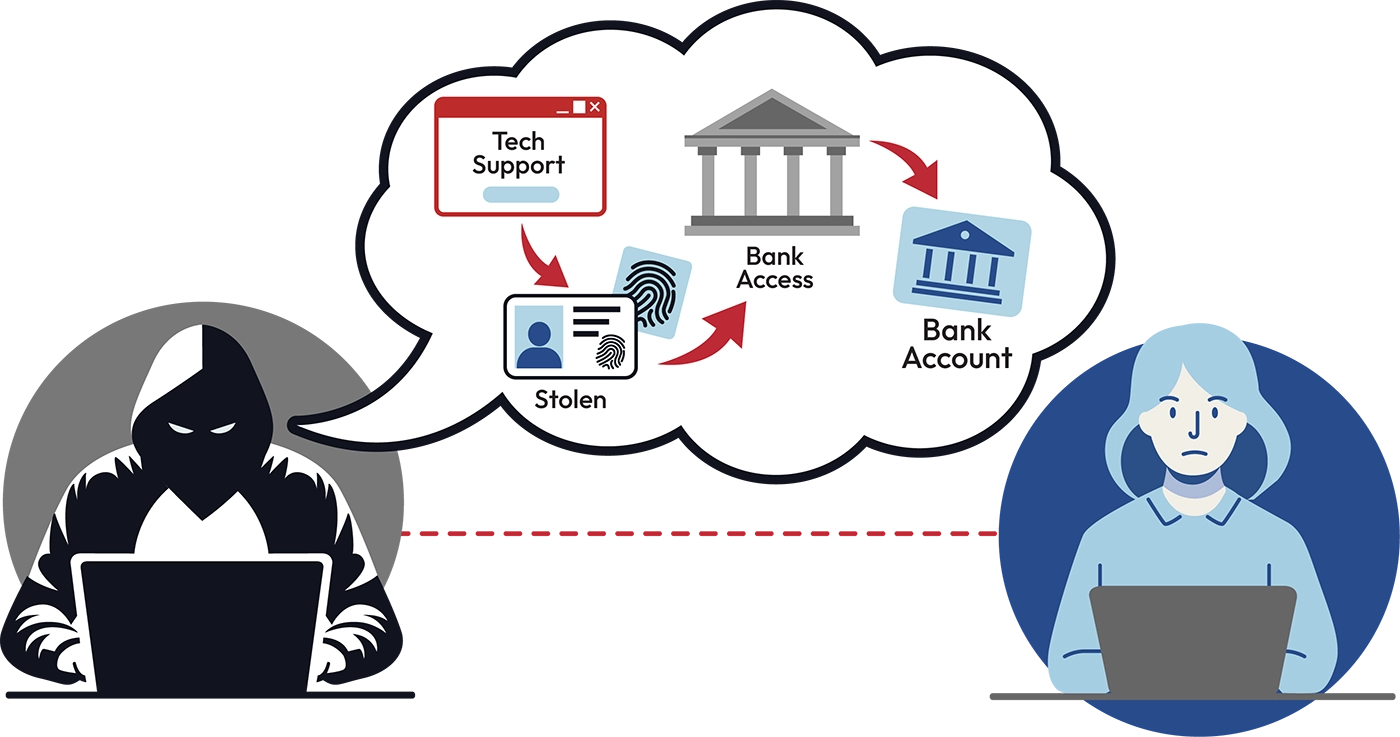
It feels real to the victim because they can mentally connect this to the fake virus pop-up they got or the tech problem they were having. Scammers often roleplay as multiple people throughout the attack, working in teams to take the victim through a rehearsed situation.
One scammer claims to be Microsoft. Another pretends to be the victim’s bank. Someone else poses as law enforcement or a government agent. Each new character reinforces the previous lie until the victim feels surrounded by authority figures all telling the same story. The victim stops asking questions and starts following instructions.
Listen to the language of one scam call where the scammers, working in a team, pretend to be tech support, the victim’s bank, and the government, all working together to resolve what started as a supposed tech problem.
The scammers manipulate the victim into transferring their entire “compromised” savings into the scammers’ bank account or talking them through withdrawing cash to convert to cryptocurrency to secure it in a “government kiosk” (aka a bitcoin ATM). Once sent, it’s irreversible and likely impossible to recover.

AI Has Entered the Equation
For the first time ever in the IC3 report, the FBI formally acknowledged and dedicated a section to the growing role of artificial intelligence in cybercrime.
According to the report, IC3 received more than 22,000 complaints involving AI in 2025, representing nearly $900 million in reported losses. In reality, that figure is almost certainly conservative. Most victims likely have no way of knowing whether an email, website, phone call, video, or online conversation they encountered was created with the help of AI.
From our own experiences investigating scams, AI has started showing up everywhere we look.



AI can now help generate convincing emails, realistic websites, fake investment platforms, drive customer support chats, and even create cloned voices for use in scams. Scammers use it to create fake virus pop-ups and websites to pair with their scripts. It polishes existing scams and removes the rough edges (things like spelling and grammatical errors) that once made scams easier to spot. It’s making them cheaper, faster, and much easier to run at scale.
The Key Takeaways
The biggest takeaways from the 2025 numbers are that scammers are becoming far more effective at stealing life-changing amounts of money, and AI is assisting scammers in making many existing scams more convincing than ever before.
Twenty billion dollars is truly hard to fathom, but scams don’t happen in billions. They happen one victim at a time.
It’s the retirement savings someone spent forty years building.
It’s the college fund grandparents saved for their grandchild.
It’s a business wiring six figures to the wrong bank account.
It’s someone taking out a loan because the “investment advisor” promised one last payment would unlock their profits.
It’s someone moving their life savings to a “secure” account because they believed they were protecting it.
It’s someone falling in love and investing with a person they thought they were building a future with.
Behind every complaint reported to IC3 is someone who genuinely believed they were making the right decision.

Shaping a Better Future
Looking at the numbers year after year, one thing has become increasingly clear: scammers aren’t just running more scams, they’re running better ones.
Today’s scam operations have expanded across nearly every corner of the internet. We’ve said before that we have struggled to find things that there aren’t scams for. But no matter the type of scam, the underlying strategy is often the same: impersonate someone or something, build trust with the victim, and get access to their money, personal information, or devices.
Modern scam operations have essentially become efficient “businesses,” with AI helping make them faster to build, easier to scale, and far more believable.
Stopping this trend will not come from any single community or organization.
It will require collaboration between researchers, financial institutions, tech companies, law enforcement, politicians, and the organizations investigating these threats every day.
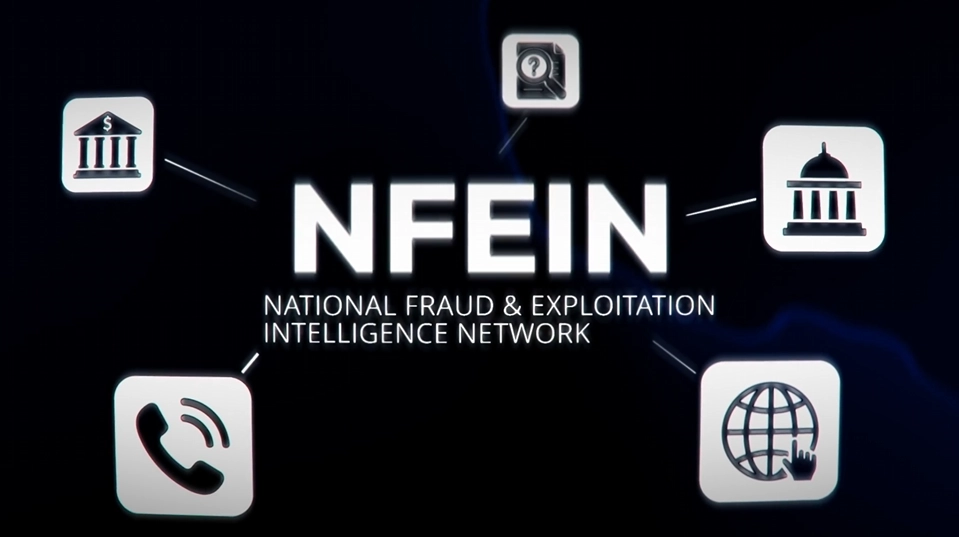
Seraph Secure is proud to be part of the National Fraud & Exploitation Intelligence Network (NFEIN) - a collaborative effort between institutions and industry partners where collective knowledge and scam signals can be shared with the goal of disrupting financial fraud at scale.
Scams will continue to evolve, and next year’s numbers may very well set another record.
Our response has to evolve even faster.
- The Seraph Secure Team